
Lindsey Graham went to Ukraine. He spoke to President Trump upon his return and he died shortly after the call. Trump said Graham sounded fine, but tired after the long flight home. Like everyone else I was concerned about the cause of Graham’s sudden death. Unlike everyone else, I can find the answers to most mysteries via the Torah Codes. I found a long, 10-letter ELS for LINDSEY GRAHAM. It is only encoded once in Torah. The R factor (explained below) is quite high. At 3.074 it converts to only having had 1 chance in 1,185 to even be found once in Torah. I had to use a row split (also explained below) of 2 to see the word POISONED. I did not have to use that split to see AND DIED or ALL WHO GO OUT TO WAR in the open text. Putin has a reputation of poioning his enemies, but neither Russia nor Ukraine are on the matrix. Russia traditionally arms the enemies of Israel, and ISRAEL is on the matrix. POISONED touches 2 letters of GRAHAM and one letter of ISRAEL.
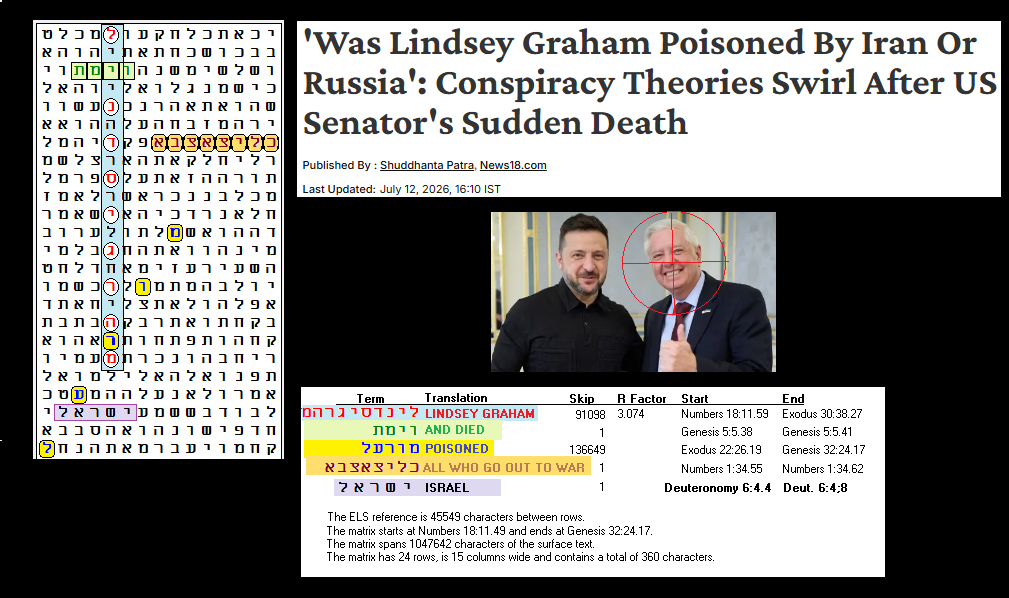
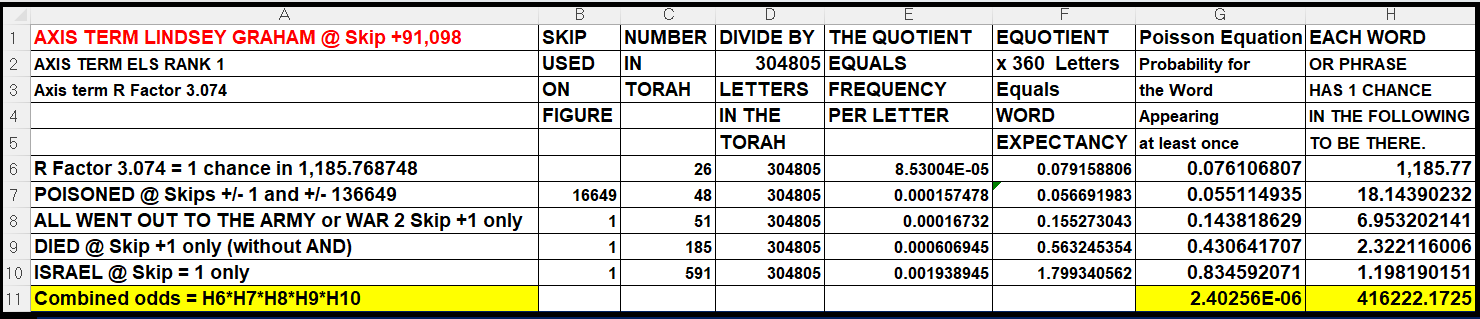
FIGURE 1 above. LINDSEY GRAHAM is the axis term. As the spreadsheet shows below, the odds against finding this matrix by chance are about 416,222 to 1. I had to use a row split of 2 to see POISONED.
EXPLANATION OF TERMS
ROW SPLIT: Normally I don’t use a row split, however it is very rare that the axis term is 10 letters long as is the case here. If I did not use a row split then the matrix would ISRAEL which is not a big deal because the name is extremely high frequency and low statistical significance. However, we would also lose POISONED which is the term of interest in the news. The senator may well have had a heart attack, but heart attacks can be induced via certain poisons. Without the row split the matrix looks like this:
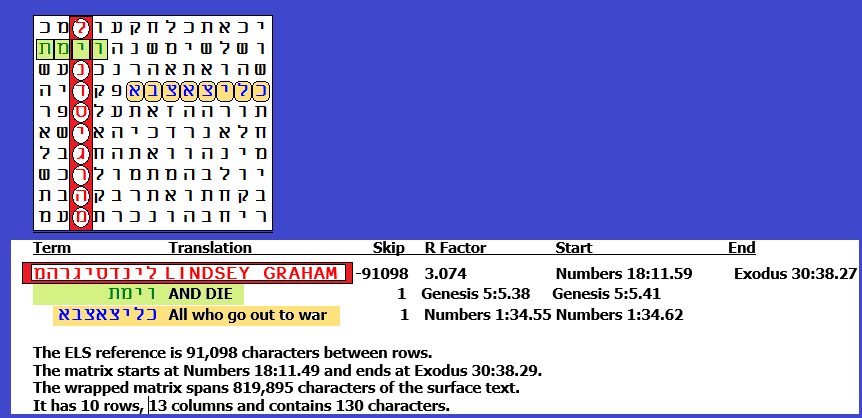
FIGURE 2 above: Thje axis term is thee same as Figure 1, but there is no row split.
Normally I require at least three letters for an a priori ELS. The word for HEART in Hebrew is only two letters (lamed vet), but I noticed that on this matrix where they occur in sequence at skip +1 they are immediately followed three letters that mean THE DEAD MAN so the five letters spell THE DEAD MAN’S HEART. That’s followed by a letter mem which means FROM. THE DEAD MAN’S HEART FROM is there with or without the row split, but with the row split THE DEAD MAN’S HEART FROM touches POISONED. There probably would be no reason to encode Graham’s naturally occuring heart attack 3,300 years ago, but the Author knew we would want to know if Graham’s death was a murder. Figure 3 is how He talks to us. Graham’s heart attack was sponsored.
The six letters at ELS +1 hinting at the cause of death are seen this way three times in Torah. They are composed of different words and can not honestly be counted as an a priori find, but if you are curious about how likely they are to be seen on the matrix below with row split 2, the answer is that the odds against finding them at skip +1 are about 282 to 1. So if everthing were found a priori (named before starting the experiment) the matrix would have been found against odds of over 117 million to 1, but in truth I only thought to look for HEART.
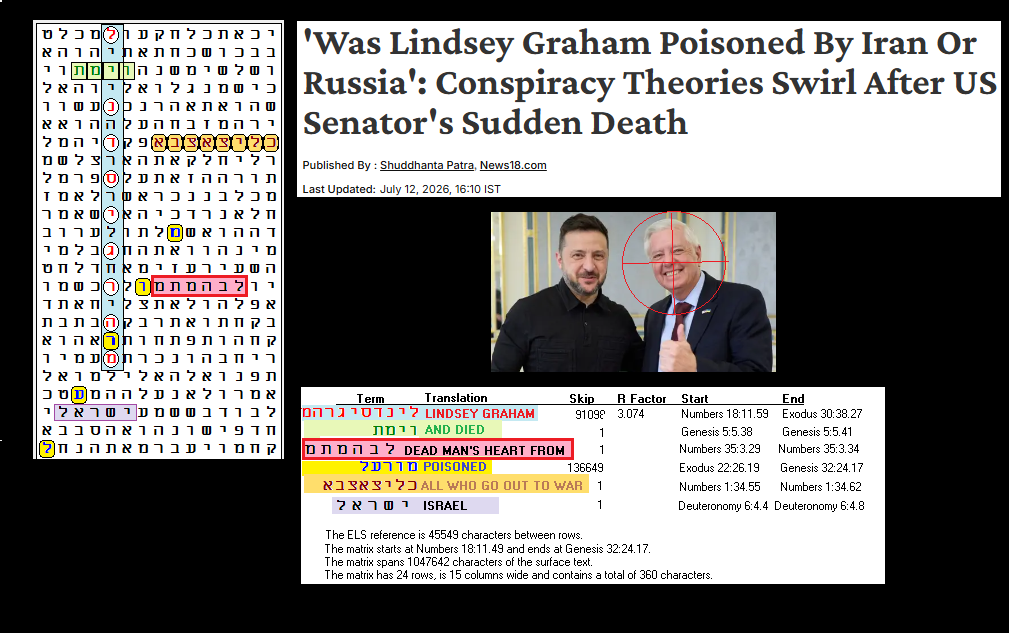 FIGURE 3 above: There was obviously damage done to Senator Graham’s heart. In looking just for the two letters for HEART I found that the Code’s Author chose to encode the cause of the DEAD MAN’S HEART with POISONED.
IN SUMMARY WITH RESPECT TO WORD SPLIT: If a term like LINDSEY GRAHAM has a skip or Equidistant Letter Sequence (ELS) of 91,098 letters, the computer will place 91,098 letters on each line of a spiraling cylinder with a circuference of 91,098 letters. When the second letter of the term arises (without a row split), it will appear directly below or above the first letter. However, if a row split of 2 is used, the computer will only place half of the 91,098 (45,545) letters on each line of a cylinder with a circumference of 45,545 letters, and there will be an extra row between each of the letters of the axis term. If a row split of 3 is used, there will be two extra rows between each letter of the axis term. The larger the row split, the more terms you can match with an axis term, but it is also true that as the row split increases, matrix significance generally decreases unless the extra row or rows contain terms of interest like POISON.
R VALUES OR R FACTORS DEFINED. Articles use the term R values, but CodeFinder software uses R factors. Consider them the same.
R VALUES. I generally don’t use Rotenberg R-values unless I’m dealing with a 10-letter axis term (or in a few cases with a 9-letter axis term that contains relatively rare Hebrew letters like tet, samech. gimel or zayin). R-values are available on Code Finder reports, but I always edit them out because I disagree with how they are used by that program. Normally I assign no value to an axis term that is 8 letters or less in length, and the higher the ELS rank of an axis term, the more I penalize the combined odds of a matrix. Here p is the probability that the characters of an ELS will match the characters of a text in a random placement. N is the number of placements of an ELS of the given skip. An R value is defined as 1/E where E = pN. E is the expected number of times that in a random letter permuted text a random placement of an ELS with absolute skip less than the absolute skip of the ELS found in the Torah text, will match the characters of the Torah text in the placement. See Code Finder: Scores or Probabilities by Dr. Robert Haralick.
As an example of an R value calculation, consider an axis term was found twice in wrapped Torah. The matrix only shows the term at the higher skip. It has an R value of 0.484 which means that based on letter frequency there is about a 32.8% chance to find it (Note: to change R value, found on the Code Finder report [in this case 0.484], to percent chance to find it, enter .484 into a scientific calculator like the TI30XA, hit second function, LOG, then 1/x and multiple by 100).
In the context of Torah Codes, the Rotenberg R-value is a mathematical tool used to measure the statistical probability of finding specific hidden words or phrases in the text. It is a logarithmic scale representing the base-10 logarithm of the reciprocal of the expected probability (\(R = \log_{10} \frac{1}{E}\)). A positive R-value (e.g., +2) means the finding is highly improbable by chance (1:100 odds). A negative R value means the finding is highly probable by chance. Do not use negative R (red) values on spreadsheets. Only use positive (blue) values. Here are some R values converted to the chance to find the term:
R value CHANCE TO BE FOUND AT LEAST ONCE IN TORAH
-2.0 0.01 EXPECT 100 TIMES IN TORAH
-1.5 0.031622777 EXPECT 31.6227766 TIMES IN TORAH
-1.0 0.1 EXPECT 10 TIMES IN TORAH
-0.5 3.16227777 EXPECT 3.16227766 TIMES IN TORAH
0 1 EXPECTED ONCE IN TORAH
0.5 0.3166227766 EXPECT ONCE IN 3.16227766 TIMES
1.0 0.1 EXPECT ONCE IN 10 TIMES
1.5 0.31622777 EXPECT ONCE IN 31.6227766 TIMES
2.0 0.01 EXPECT ONCE IN 100 TIMES
3.0 0.001 EXPECT ONCE IN 1,000 TIMES
3.074 0.000843335 EXPECT ONCE IN 1,185 TIMES IN TORAH. This applies to Lindsey Graham.
.