
Sometimes a story can make great headlines but not come to fruition. On July 20, 2026 there were headlines again about New York’s communist Mayor Zohran Mamdani wanting to arrest Israeli Prime Minister Netanyahu when Netanyahu comes to New York to speak at the U.N. That’s the same U.N. where terrorist Yaser Arafat was allowed to speak to all with a loaded pistol on his side. If the Torah really does have the entire history of our planet precorded, then the Mamdani story should appear, but I speculate that when it does show up, the reason it was not edited out by the Author was to allow for free will to remain viable. Life is full of surprises, but I cannot see how or why Mamdani’s police would try to overcome our President and all Military or Federal police forces in an insame act of trying to arrest Trump’s friend. The spreadsheet shows that there were no a priori terms found other than Netanyahu with a moderately high significance. Three terms were easier to find than calling a coin toss correctly.
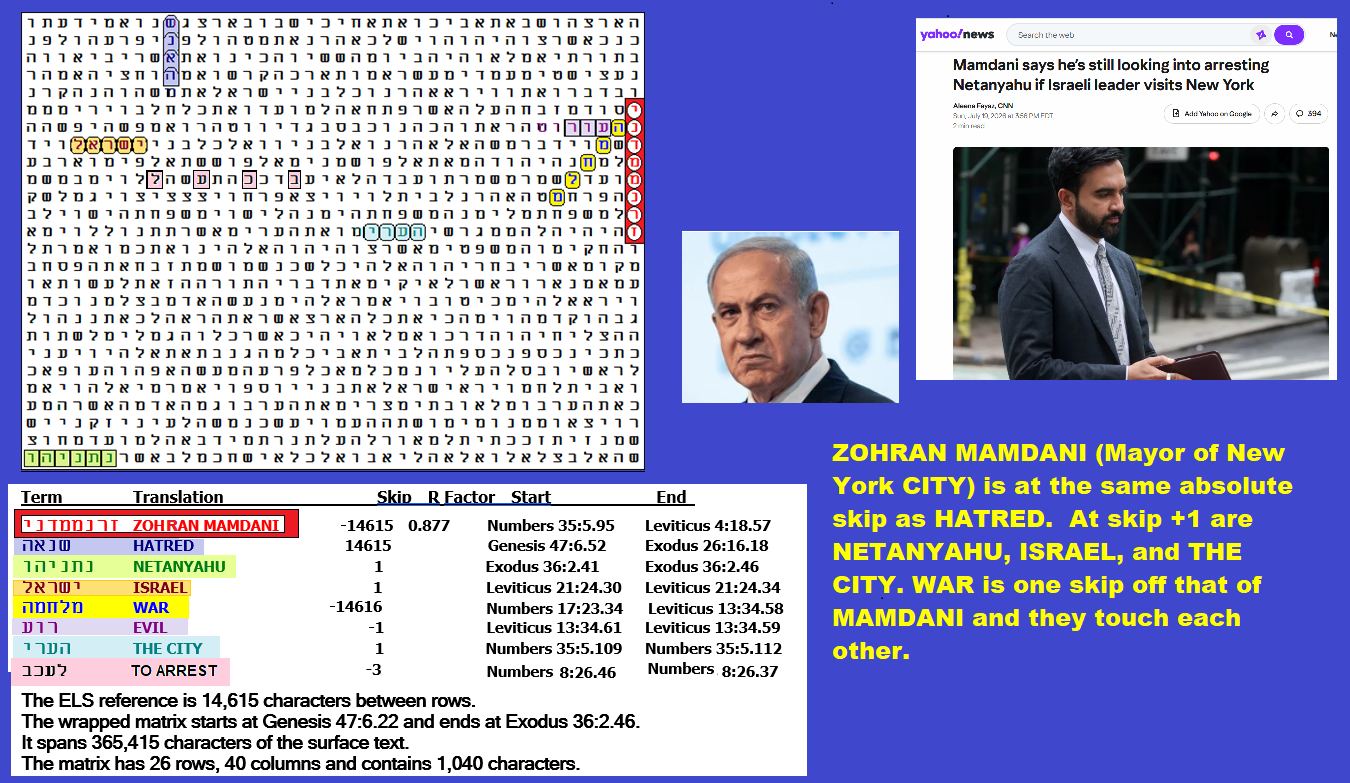
The way to recognize matrix significance may be related to how we judge a matrix statistically. This last statement is absolutely vital to undestanding the Torah Code. Are the key a priori terms significant or not? A word that often fools people this way is ISRAEL. Figure 1 has 8 terms, but the combined significance shown is under 10,000 to 1 which is relatively low for a matrix this size. Also I usually limit matrix size to under 1,000 letters. Figure 1 is 1,040 letters.
As the spreadsheet for Figure 1 below shows, the word ISRAEL is extremely high frequency, occurring at 591 times in Torah. Torah is almost entirely the early history of the Jewish people and how they came to the land of Israel. There are 304,805 letters and 79,980 words in Torah. The last word is ISRAEL – which is made of the last five letters of Torah. As the spreadsheet shows, on a matrix as large as Figure 1, there was more than an 86.68% chance that Israel would be on the matrix. While ISRAEL is not significant, NETANYAHU only had about a 5.31% chance to be there which is moderately significant. NETANYAHU appears at skip +1 sixteen times in Torah.
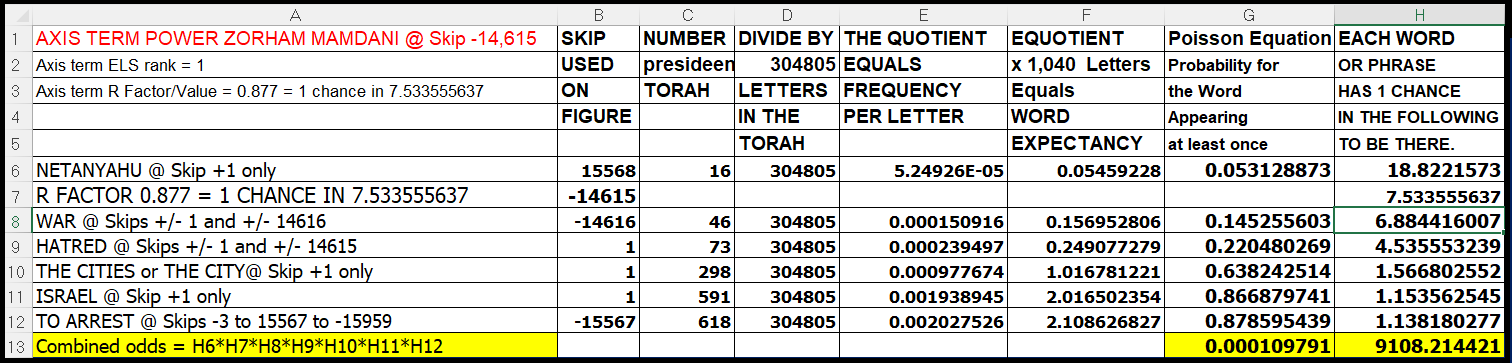
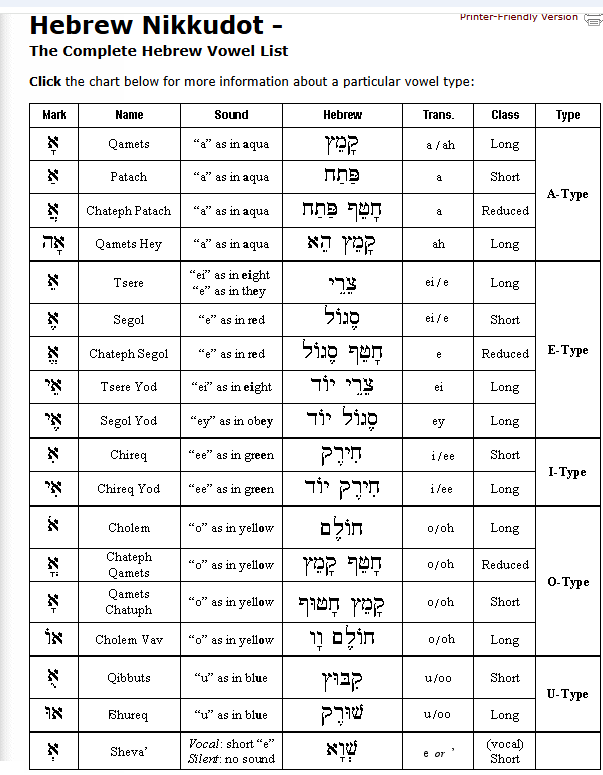
What about MAMDANI? There were a few transliterations of his last name that could be found but not with a first name or term in sequence that was of interest. When it comes to names, transliterations are fine. My first name is Barry. I could write it as Bet Alef Resh Resh Yud. Although it’s a letter for letter match for the English, it is not a spelling that Israelis would use. I have many Hebrew documents – all produced by the Israeli Government. They only use three letters for my first name – Bet Resh Yud (essentially BRY). Likewise, to get ZOHRAN we could get by with Zayin Resh Nun (ZRN) which is what I found on Figure 1. Vowel marks are not shown in a kosher Torah, They are implied and are only shown in a Chumash. The Torah and the Chumash contain the exact same text—the Five Books of Moses. The difference lies purely in their format and usage. A Torah is a sacred, handwritten parchment scroll used in the synagogue. A Chumash is a bound, printed book version used for personal study, often including vowels, translations, and commentaries. Vowels are shown below. It takes about an hour to chant each week’s portion of Torah. The reader (a baal koreh – master of the reading) must try to memorize the vowels and musical notes before chanting it. All the vowels are shown in Figure 2 below:
 COST OF A CHUMASH vs. TORAH. While a new Chumash cost about $50, a new kosher Toran cost between $20,000 and $60,000. It takes a year to write one. Scribes with renowned expertise or higher aesthetic precision for the lettering command premium prices, with some scrolls reaching $100,000 or more.