MARS CORRECT BASIC REPORT - SECTIONS 15.2 TO 15.3
Importance of Winter Ground Temperatures and Possible Life Spotted on MSL Sols 1185, 1189, 1555, 1571 and 1797. Updated on 2/14/2020.
15.2 Winter ground temperatures above freezing in MSL Year 2.
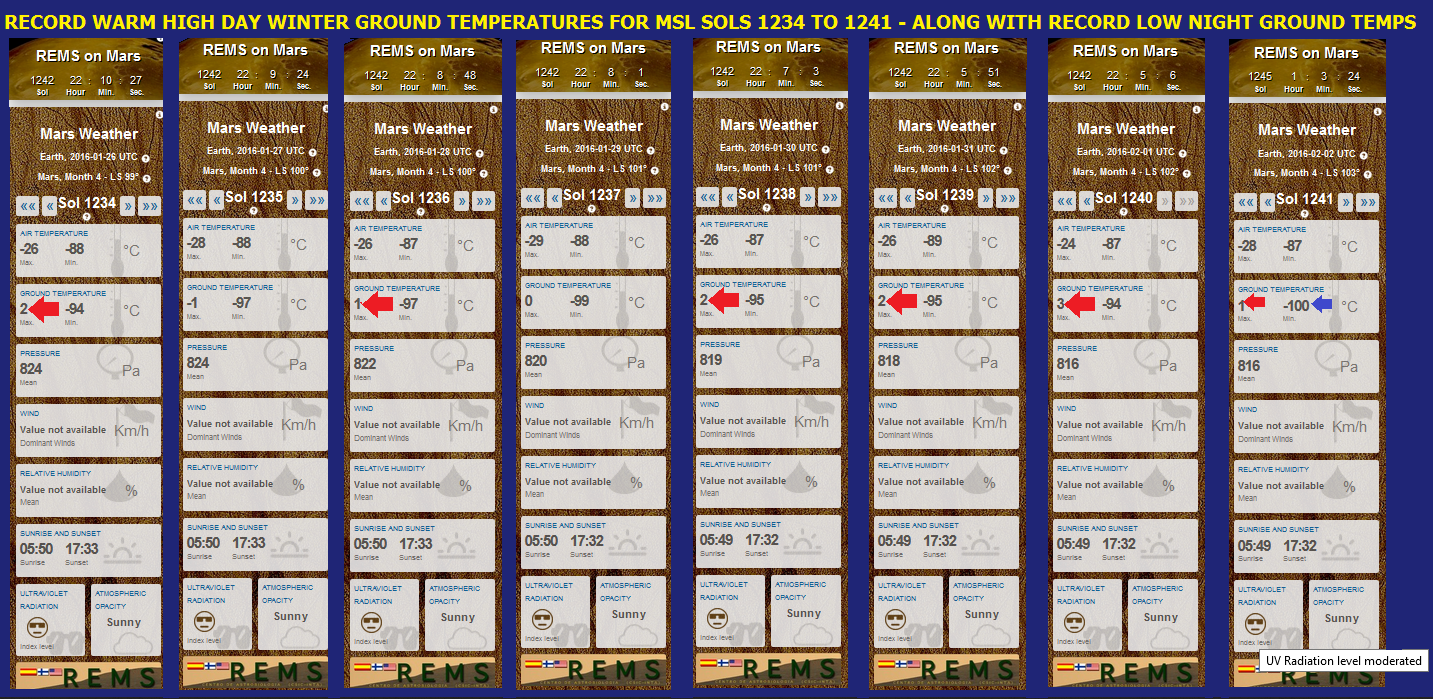
Just after the second winter solstice (Ls 90) at MSL on Mars ground temperatures recorded climbed to above freezing. No such temperatures were recorded anywhere near that time in MSL's Year 1. What was even weirder was that while ground temperature highs were record highs for that time of year, nighttime lows were record lows. We looked at whether the MSL was on a slope that might impact angle of incidence of solar rays and therefore temperature, much as was apparent with respect to times that Recurring Slope Lineae (RSL) occurred in association with supposed running water on Mars. However, on the evening of 9 February 2016 we found an MSL position image at http://mars.nasa.gov/msl/mission/whereistherovernow/ which showed elevations and positions for many sols between Sol 1173 (Ls 72 which is late autumn at MSL) and Sol 1248 (Ls 106). We captured it by print screen and adapted it by addition of maximum and minimum ground temperatures. See Figure 73 below. Note that all temperatures above freezing occurred when MSL moved little for about 3 weeks in an area where there was a two meter change in elevation over a 10 meter distance. This is a 20% grade (an 11.3° slope).

As of May 14 2016 it appears that the high air or ground temperature is above 0° C at Gale Crater on at least 411 days of the 669 sols in a Martian year. This number is based on at least one above freezing sol in either MSL Year 1 or 2 at the same Ls. Surprisingly the number increased in early winter of MSL Year 2 on 16 sols between Ls 95 and 104 with above freezing ground temperatures of +1, +1, +2, +1, +1, +1, +1, +1, +1, +2, +2, +2, +3, +1, +2 and +1 °C found where in Year 1 the ground temperatures on those days were -7, -6, -3, -6, -5, -9, -11, -8, -8, -13, -7, -7, -8, -8, -10 and -9° C. There were also five sols (1222, 1223, 1230, 1237 and 1244) at Ls 94, 98, 101 and 104 where the ground temperature in Year 2 was 0° C while in Year 1 it was only -10, -7 -5, -9 and -10° C. A quick summary for this 24-sol period each year is given on Table 21. A more extensive summary can be found below on Figures 71 and 73.
15.3 Why the early winter ground temperatures are so important and possible life seen on Sol 1185.
On Sol 1185, and to a lesser degree on Sol 1189 and later there were items seen on Mars that look like life. See Figure 71. On Sol 1185 they were near what looked like either a geode split open, or possibly a cocoon of some sort. The green color was suggestive of something that might be photosynthetic. The shape would allow Martian winds to move these objects so they could reach nutrients. Moreover, while some cells (if they are there) would benefit from sunlight while facing the sun, those on the bottom would not - unless the sphere shape evolved to allow the bottom cells to reach the top. Is there something analogous in Earth-based botany? Yes. When the cross section of a leaf is examined under a microscope, chloroplasts in the Palisade layer move from top to bottom and back to the top again as the cytoplasm in the cells circulates. This ensures that all chloroplasts get a chance to move up to just under the epidermis so they can absorb more ultraviolet light from the sun and increase the rate at which photosynthesis occurs, Of course, in photosynthesis carbon dioxide and water combine to form sugar (glucose) and oxygen. The Martian atmosphere is supposed to be 95% carbon dioxide, running water is believed to be found in association with RSL in Gale crater, and JPL has announced evidence for brine found by MSL.
| TABLE 21 - USUALLY WARM GROUND TEMPERATURES EARLY IN THE WINTER OF MSL YEAR 2 | ||||||||
| MSL YEAR | LS RANGE | SOL RANGE (24 sols) | AVERAGE DAY AIR TEMP HI ° C | AVERAGE NIGHT AIR TEMP LO ° C | AVERAGE DROP IN AIR TEMP DAY TO NIGHT | AVERAGE DAY GROUND TEMP HI ° C | AVERAGE NIGHT GROUND TEMP LO ° C | AVERAGE DROP IN GROUND TEMP DAY TO NIGHT |
| 1 | 93 TO 104 | 552 TO 575 | -26.66667 | -84.9583 | -58.2916 | -8.45833 | -90.79167 | -82.3233 |
| 2 | 93 TO 104 | 1,221 TO 1,244 | -26.79167 | -87.45833 | -60.6666 | +0.79167 | -96.54167 | -97.3333 |

Figure 71 - The green spherical and cocoon-like objects were seen on sols 1185 and 1189. The green spheres might be photosynthetic life. As mentioned with Figure 58 below, MSL returned to the area again on Sol 1248, possibly for a further look or tests to see if this is life. More spheres were seen on Sol 1555, 1571 and 1797.
While the initial look at the possible life was largely between sols 1185 and 1189, on Sol 1248 MSL returned to within 20 meters of the site and it was within less than 10 meters from the site on Sol 1249. See Figure 73.
Kiepe continued to find spheres up through at least MSL 1,797. Altitude variation from Sol 1185 up through 1797 was from about 4,420 meters below areoid up to 4,215 meters below areoid, an increase of 205 meters (672.572 feet).
FIGURE 72A – The putative ooids found in the same area as the spheres shown on Figure 71 might be simply smaller versions of the same phenonena. FIGURE 72B below shows likely growith and reproduction of Martian puffballs (fungi).
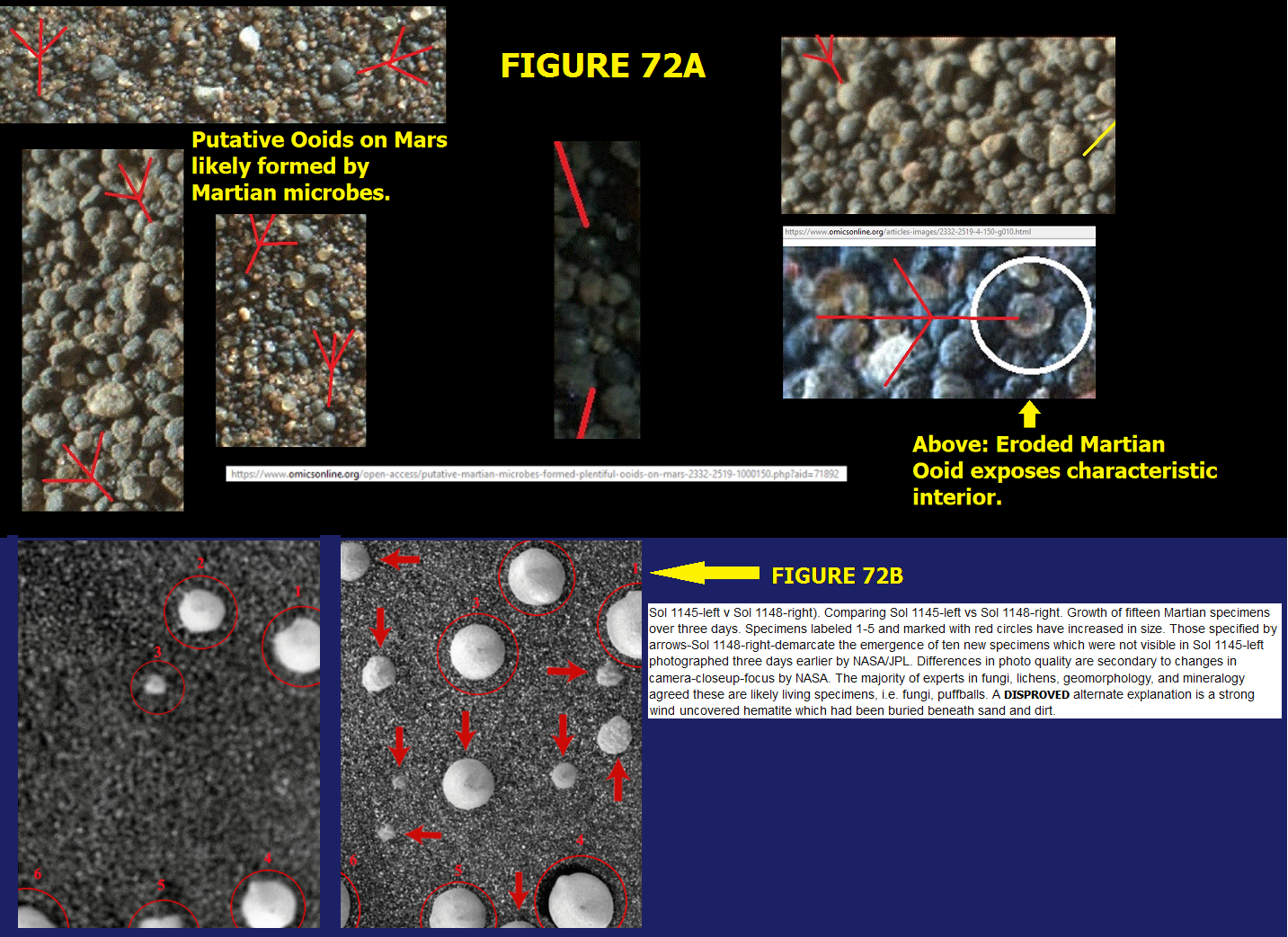
David Kiepke was apparently not the only one who thought he was looking at life on Mars around Sol 1185. A research paper by Laingtai Lin119 entitled Putative Martian Microbes Formed Plentiful Ooids on Mars (2016) states in its abstract that:
NASA’s Mars Rover Curiosity discovered plentiful indigenous spherical ooids at High Dune and Namib Dune in Bagnold dune field, Gale Crater, Mars. The Martian ooids measure about 0.2 mm to 0.5 mm in diameter. Colors of the Martian ooids are various, including white, yellow translucent, green, grey, and yellow. The Martian ooids should have been formed by microbes, because ooids of Earth have recently been found to be formed by microbes and microbial borings are found in ooids of Earth and of Mars. The Martian ooids are unlikely to have been formed by non-biological mechanisms, because there was no highly agitated water at the discovery sites.
Namib Dune, mentioned in Lin’s paper, was shown above on Figure 71. Some of the ooids described by Lin are shown on Figure 72A.
15.3.1. Evidence of Life on Mars. The Journal of Astrobiology published Evidence of Life on Mars by R. Gabriel Joseph et al. in June, 2019.152 The Journal has also asked us for a commentary on the above astounding find of likely lichens, alga, bacteria, fungi (including puff balls), cyanobacteria and stromatolites on Mars. Our article, entitled Meteorological Impact of Evidence of Life on Mars is published under the name of David Alexander Roffman, Ph. D.153 There is an acknowledgement for Barry S. Roffman. This was the wish of the publisher, however as the acknowledgment indicates our father and son team have been full partners in all Mars research for a period of ten years now.
The Joseph et al. (2019) paper argued that the spheres shown apparently growing and reproducing on Figure 72B below were likely puffballs (fungi), but they conceded that NASA might be right that wind was blowing away sand this revealing more of what was only hematite. Our paper (Roffman, 2019) showed that if NASA is correct about low pressure in the Martian atmosphere, the wind was never strong enough to do that. Therefore Figure 72B almost certainly is proof of life. And what if the atmosphere is two orders of magnitude denser than NASA admits? Then all NASA Mars weather data is worthless. Heads we win, tails they lose. The wind speeds for Mars are documented in Section 7.2.1 of this report. In particular see Table 13 plus Figures 28 and 29.
Figure 73 – Elevations and ground temperatures encountered while MSL was at positions noted by JPL. Possible life was seen on Sol 1185, along with a warmer than expected high ground temperature. The position noted for MSL for Sol 1248 is a return to within 20 meters of where the potential life was seen before. Then it moved within about 10 meters of the site. See Figure 71 to view the suspected life.
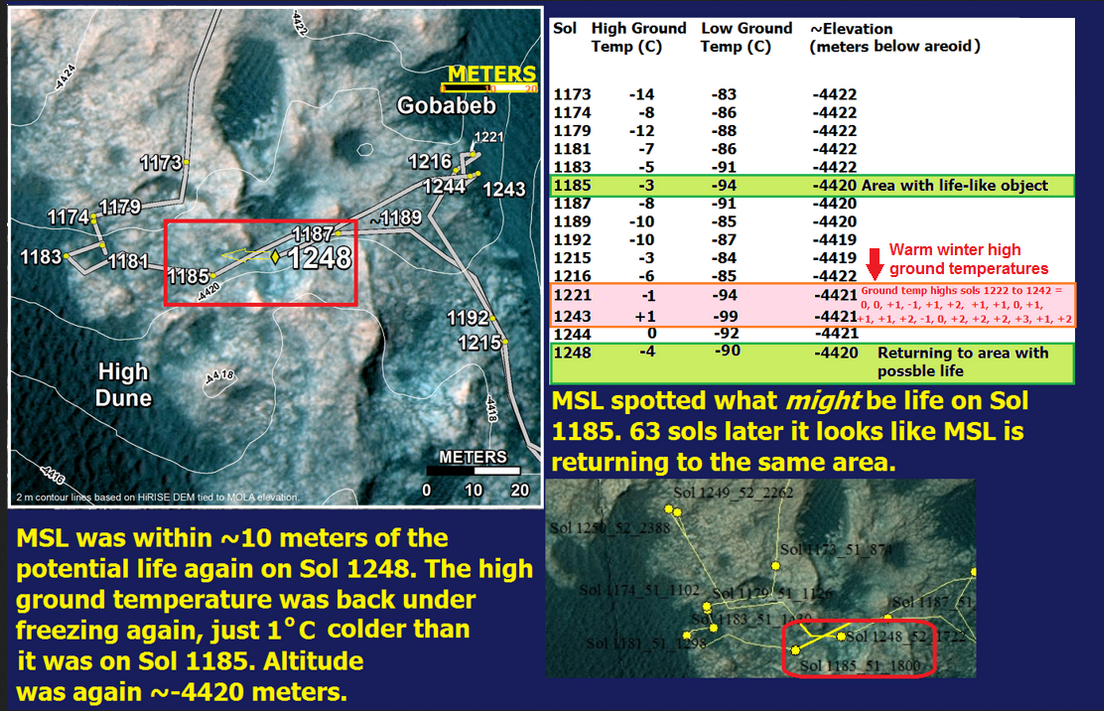
Figure 74 - Some of the unusually warm ground temperatures including six above freezing seen early in MSL Year 2 Winter.